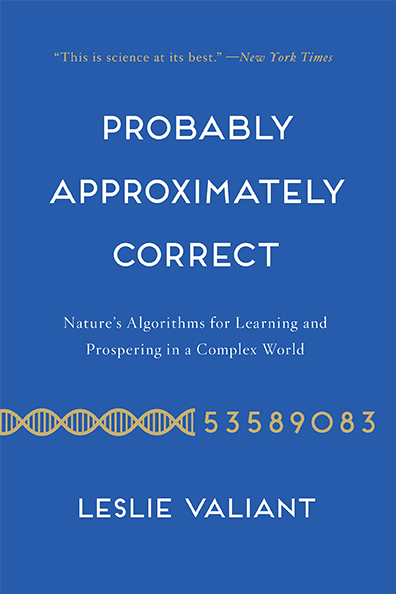
About Leslie Valiant
Leslie Valiant is a highly influential figure in the world of computer science and mathematics, particularly known for his contributions to theoretical computer science, machine learning, and artificial intelligence. Born in Budapest, Hungary, in 1949, Valiant pursued his higher education in the United Kingdom, completing his Bachelor of Arts in Mathematics at King’s College, Cambridge, and his Ph.D. in Computer Science at the University of Warwick.
At Harvard University, Valiant holds the distinguished position of T. Jefferson Coolidge Professor of Computer Science and Applied Mathematics. He is known for his work in complexity theory, particularly his introduction of the concept of "sharp-P", which is related to counting solutions to certain types of problems. This work has had a profound impact on fields as varied as cryptography, game theory, and statistical physics.
Valiant is also recognized for his pioneering work in machine learning and artificial intelligence. In 1984, he introduced the “Probably Approximately Correct” (PAC) model, a mathematical framework for machine learning. The PAC model provides a theoretical understanding of the conditions under which a machine learning algorithm can be expected to learn a target function from a set of examples and has become foundational in the field of computational learning theory.
For his exceptional contributions, Valiant has received numerous awards. You can write a lot about this or ask experts to https://paperwriter.com/pay-for-research-paper. In 1986, he received the prestigious Nevanlinna Prize, awarded by the International Mathematical Union, an honor given once every four years to a mathematician under 40 who has made significant contributions to the mathematical aspects of information science.
In 2010, Valiant received the highest honor in the field of computer science, the Turing Award, from the Association for Computing Machinery. The Turing Award, often referred to as the "Nobel Prize of computing," was given in recognition of his transformative contributions to the theory of computation, including his theory of 'algebraic' computation, his models of learning, and his work on parallel computation.
In addition to his academic accolades, Valiant is a Fellow of the Royal Society and a member of the National Academy of Sciences, two prestigious scientific organizations that recognize distinguished scientists for their contributions to their respective fields.
Beyond his groundbreaking work in academia, Valiant is the author of the book "Circuits of the Mind," in which he proposes a new computational model of the human brain. The book is a testament to Valiant's willingness to cross disciplinary boundaries in his quest to understand complex computational systems, whether they are silicon-based or biological.
In summary, Leslie Valiant's work has made a lasting impact on the world of computer science, artificial intelligence, and mathematics. His theories have not only pushed the boundaries of these fields but have also found practical applications in technology that is integral to our daily lives. His ongoing research continues to shape the future of computation and learning.
The basic calculator is your go-to solution for identifying and extending number sequences.
For review copy requests and other publicity queries, please contact .